About Sensocon USA Differential Pressure Transmitter Series DPT10-R8 - Range -12.5 - 12.5 mbar
Sensocon USA Differential Pressure Transmitter Series DPT10-R8 - Range -12.5 - 12.5 mbar
APPLICATIONS
DPT-R8 series devices are commonly used in HVAC/R systems for: Fan, blower and filter monitoring Pressure and flow monitoring Valve and damper control Pressure monitoring in clean rooms
WARNING
READ THESE INSTRUCTIONS CAREFULLY BEFORE ATTEMPTING TO INSTALL, OPERATE OR SERVICE THIS DEVICE.
Failure to observe safety information and comply with instructions could result in PERSONAL INJURY, DEATH AND/ OR PROPERTY DAMAGE.
To avoid electrical shock or damage to equipment, disconnect power before installing or servicing and use only wiring with insulation rated for full device operating voltage.
To avoid potential fire and/or explosion do not use in potentially flammable or explosive atmospheres.
Retain these instructions for future reference.
This product, when installed, will be part of an engineered system whose specifications and performance characteristics are not designed or controlled by Sensocon. Review applications and national and local codes to assure that the installation will be functional and safe. Use only experienced, knowledgeable, technicians to install this device.
SPECIFICATIONS
Performance Accuracy (at applied pressure) Ranges < 0.5 inWC = 0.01 inWC Ranges 0.5 inWC = 1.5% inWC Accuracy specifications include: general accuracy, temperature drift, linearity, hysteresis, long term stability, and repetition error
Thermal Effects Temperature compensated across the full spectrum of capability
Overpressure Proof Pressure: 100 inWC Burst Pressure: 120 inWC
Zero Point Calibration Automatic with function or Manual push-button Auto-Zero
Response Time 4.0 0.8 sec, Selectable via Jumper
Technical Specifications Media Compatibility Dry air or non-aggressive gases
Measuring Units (select via Jumper) Pa, kPa, mbar, inWC, mmWC Measuring Element Piezoresistive
Environment: Operating Temperature: 14 122F (-10 50C) Storage Temperature: -4 158F (-20 70C) Humidity: 0 to 95 % rH, non condensing
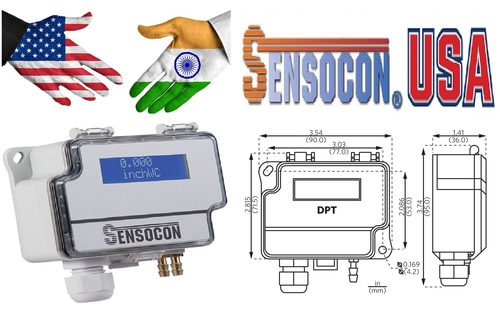
Physical Case Dimensions: 3.54 x 3.74 x 1.4 (90.0 x 95.0 x 36.0 mm) Weight: 5.3 oz (150 g) Mounting: 2 each 0.1875 (4.3 mm) screw holes, one slotted Materials: Case: ABS (UL 94 V-0 Approved) Lid: PC (UL 94 V-1 Approved) Protection standard: IP54 / NEMA3
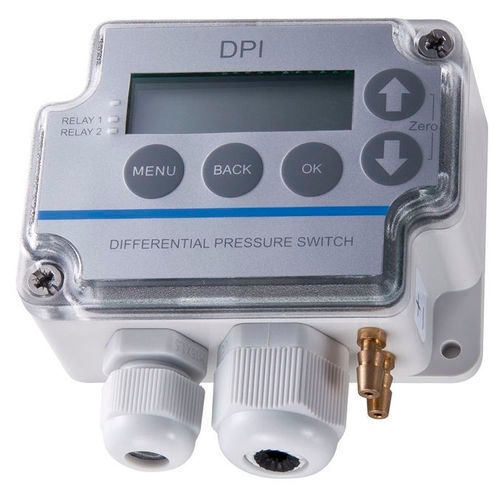
Display (optional) 3 1/2 Digit LCD Backlit Display 2-Line Display (12 character/line) Size: 1.81 W x 0.57 H (46.0 x 14.5 mm)
Electrical connections: 4 screw terminal block Wire: 12-24AWG (0.2 1.5 mm2
Cable Entry Strain Relief: M16 Knockout : 0.625 (16mm)
Pressure Fittings 3/16 (5.2mm) barbed brass + High pressure Low pressure
Electrical Voltage Circuit: 3-wire ([V Out], 24V, GND) Input: 24VAC or VDC, 10% Output: 0-10V or 0-5V, selectable via Jumper Power Consumption: <1.0W Resistance Minimum: 1k
Current Circuit: 3-wire (mA Out, 24V, GND) Input: 24VAC or VDC, 10% Output: 4
Precise Differential Pressure MeasurementDesigned specifically for air and non-combustible gases, the DPT10-R8 delivers reliable differential pressure readings ranging from -12.5 to 12.5 mbar. Its fast response time, electronic processing, and LED digital display ensure real-time monitoring crucial for industrial and HVAC settings.
Rugged and Versatile ConstructionEncased in anodized aluminum and ABS plastic, this transmitter can withstand harsh environments and overpressure up to 150 mbar. The IP54 protection rating and silicone seal make the device suitable for cleanrooms, HVAC systems, and filter monitoring, while maintaining long-term durability.
Effortless Adjustment and InstallationFeaturing front-panel zero and span adjustment, the DPT10-R8 allows quick on-site calibration. Its compact housing (80 mm diameter front plate), screw terminal electrical connection, wall/surface mount design, and included mounting kit ensure straightforward installation and integration into existing systems.
FAQs of Sensocon USA Differential Pressure Transmitter Series DPT10-R8 - Range -12.5 - 12.5 mbar:
Q: How can I install the Sensocon DPT10-R8 Differential Pressure Transmitter in my HVAC system?
A: The DPT10-R8 can be surface or wall-mounted using the included mounting kit. Electrical connection is made through screw terminal blocks, and the transmitter is powered by a 24V DC supply. Simply connect the 1/8 NPT female threaded process ports to your air ducts or filter lines.
Q: What types of applications is the DPT10-R8 suitable for?
A: This differential pressure transmitter is ideal for HVAC applications, cleanroom pressure control, and filter monitoring. It measures air and other non-combustible gases, providing precise monitoring for industrial-grade environments.
Q: When should I adjust the zero and span settings on this transmitter?
A: Zero and span adjustment is typically required during initial installation, after maintenance, or if there are noticeable drifts in the pressure readings. Adjustments are easily accessible via the front panel for on-site calibration.
Q: Where are the adjustment controls and electrical connections located on the device?
A: Zero and span adjustment controls are situated on the front panel, allowing access without removing the transmitter from its mount. Electrical connections are made through the screw terminal blocks positioned at the back or side of the housing.
Q: What is the process for calibrating the transmitter for optimal accuracy?
A: To calibrate, apply known reference pressures at the process ports and use the front-panel controls to adjust zero and span until the LED display matches the applied values. This ensures the transmitter operates within its specified 1% accuracy range.
Q: How does using this transmitter benefit my air monitoring systems?
A: By offering fast response times (less than 1 second), high accuracy, and real-time digital readouts, the DPT10-R8 enhances system performance, helps optimize energy consumption, and maintains air quality standards in your facility.
Q: What should I do if the transmitter is exposed to pressures above its rated range?
A: The DPT10-R8 is designed to withstand up to 150 mbar overpressure briefly without damage, but repeated overpressure should be avoided to preserve sensor accuracy and longevity.






 Send Inquiry


 Send Inquiry


