About Sensocon USA 212-D050K-3 Differential Pressure Transmitter
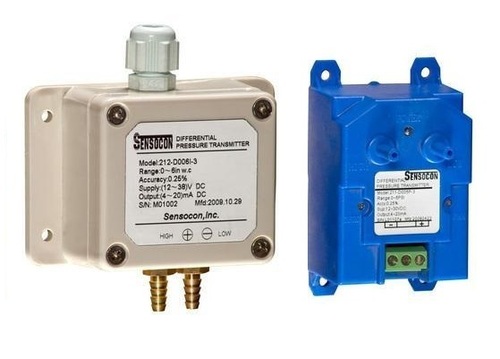
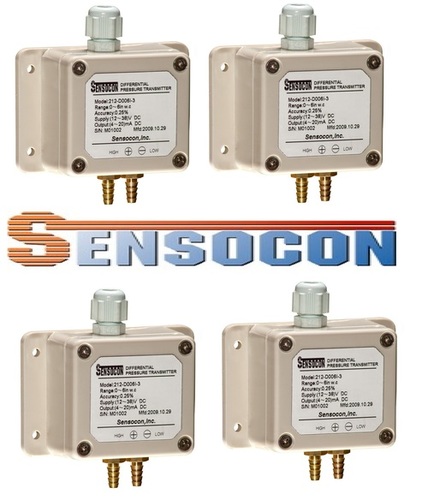
Sensocon USA 212-D050K-3 Differential Pressure Transmitter
- Model 212-D050K-3
- Pressure Range 50K-3
- Accuracy 1%
- Compact Design
- 0.25% Accuracy
- LED Power Indication
- 4 20 mA or 0 10 V output
The Series 211 Differential Pressure Transmitter can accurately measure positive, negative, or differential pressure and send the corresponding 4 20 mA output signal. The Series 211 Differential Pressure Transmitter is not position sensitive and can be mounted in any orientation without compromising accuracy. It also features a power LED, so you always know when the transmitter is operating. The compact, lightweight design makes installation simple and easy.
SPECIFICATIONS- Maximum Pressure:
- Ranges 5 PSI (35 kPa) = 15 PSI (100 kPa) Max Ranges > 5 PSI (35 kPa) = 30 PSI (200 kPa) Max
- Media Compatibility:
- Air and compatible noncombustible, non-corrosive gasses
- Accuracy:
- Ranges 4 w.c. (1 kPa) 1.0% Ranges 5 w.c. (1.25 kPa) 0.25%
- Temperature Ranges:
- Compensated: 15 to 120F (-10 to 50C) Operating: -10 to 155F (-25 to 70C)
- Thermal Effect:+/- 0.028% FS/F (+/- 0.050%/C)
- Stability: +/- 0.25% FS/year
- Output Signal: 4-20 mA, 2 wire or 0-10V
- Loop Resistance: 250 @ 24 VDC
- Power Supply: 12-30 VDC
- Housing Material: ABS Plastic
- Electrical Connections: screw terminals
- Process Connection: Push on connection for 3/16 I.D. tubing
- Agency Approvals: CE
Industrial Precision and VersatilityDesigned for demanding environments, the 212-D050K-3 delivers reliable differential pressure measurements with an accuracy of 1.0% FS across a broad 0-50 kPa range. The unit is suitable for measuring air and non-corrosive gases, making it invaluable for HVAC management, filter monitoring, and cleanroom pressure control.
User-Friendly Design and Easy InstallationThe transmitters compact form factor, digital display, and included mounting bracket ensure hassle-free installation on any wall. Its robust screw terminal block simplifies electrical connections, and its powder-coated ABS casing offers enhanced durability in industrial settings. Accessories and manuals are included for quick setup.
FAQs of Sensocon USA 212-D050K-3 Differential Pressure Transmitter:
Q: How do I install the Sensocon 212-D050K-3 Differential Pressure Transmitter?
A: Begin by selecting a suitable wall surface near your process media. Use the included mounting bracket to secure the transmitter. Connect the process lines to the 1/8 NPT threads, then wire the device using the screw terminal block as per the installation manual. Ensure the power supply is between 12-36 VDC.
Q: What types of media can the 212-D050K-3 measure?
A: This transmitter is designed to measure the differential pressure of air and non-corrosive gases only. It should not be used with corrosive or liquid media, as this can damage the internal sensor and affect performance.
Q: When should I use this differential pressure transmitter in my process?
A: The 212-D050K-3 is ideal when precise, rapid, and reliable pressure measurements are essential, such as in HVAC system monitoring, filter performance evaluation, and cleanroom environment management. Its swift response time ensures real-time data for process control.
Q: Where can this transmitter be installed for optimal results?
A: Install the transmitter in clean, dry indoor environments with ambient temperatures between 0C and +50C. Avoid exposure to excessive moisture or corrosive atmospheres to maintain its IP54 protection and ensure lasting performance.
Q: What benefits does the digital display offer in practical usage?
A: The integrated digital display provides immediate visual feedback of current pressure readings, enabling onsite personnel to quickly assess system status without additional equipment. This enhances operational efficiency and facilitates routine maintenance checks.
Q: How does the IP54 protection class benefit industrial users?
A: The IP54 protection ensures that the transmitter is shielded against dust ingress and water splashes, making it suitable for industrial environments where such exposure is common, thus extending the longevity and reliability of the device.






 Send Inquiry


 Send Inquiry


