About Sensocon USA 212-D002K-3 Differential Pressure Transmitter
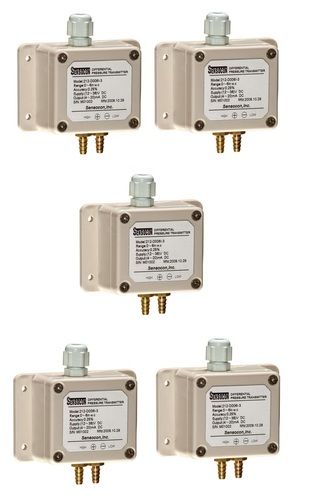
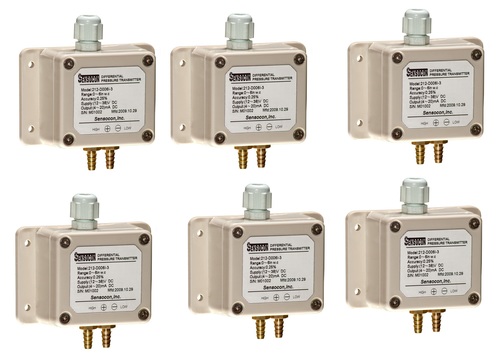
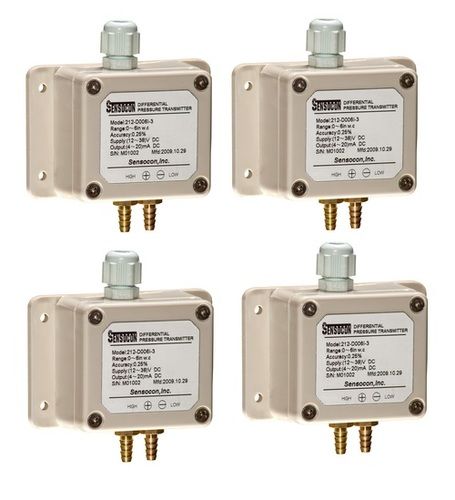
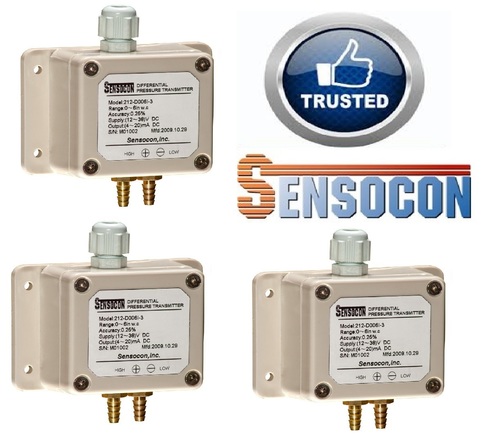
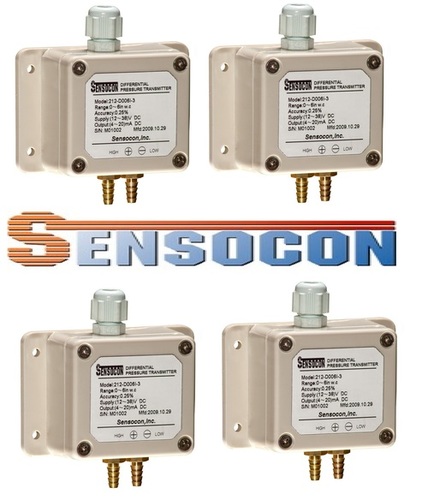
Sensocon USA 212-D002K-3 Differential Pressure TransmitterThe Series 212 Weatherproof Differential Pressure Transmitter can accurately measure positive, negative, or differential pressure and send a corresponding 4-20 mA or 0-10 V output signal. The Series 212 Weatherproof Differential Pressure Transmitter is designed with an IP 65 enclosure and can be easily mounted to any flat surface. The Series 212 is not position sensitive and can be mounted in any orientation without compromising accuracy. The compact, lightweight design makes installation simple and easy.SPECIFICATIONS - Maximum Pressure: Ranges 5 PSI (35 kPa) = 15 PSI (100kPa) Max Ranges > 5 PSI (35 kPa) = 30 PSI (200kPa) Max
- Media compatibility: Air and compatible non-combustible, non-corrosive gases
- Accuracy: Ranges 4" w.c. (1kPa) 1.0%Ranges 5" w.c. (1.25kPa) 0.25%
- Temperature Ranges: Compensated: 15 to 120F (-10 to 50C)Operating: -10 to 155F (-25 to 70C)
- Thermal Effect: +/- 0.028% FS/F (+/- 0.50% FS/C)
- Stability: +/- 0.25% FS/year
- Output Signal: 4-20 mA, 2-wire or 0 - 10 V
- Loop Resistance: 250 @ 24 VDC
- Power Supply: 12-30 VDC
- Enclosure Rating: IP 65
- Electrical Connections: screw terminals
- Electrical Entry: PG7 Cable Gland
- Process Connection: Barbed fittings for 3/16 flexible tubing
- Agency Approvals:CE
High Accuracy and Fast ResponseThe Sensocon 212-D002K-3 transmitter ensures high-precision pressure monitoring with 1% full-scale accuracy and a response time of less than 25 milliseconds. The digital display and 4-20 mA output allow for immediate integration and reliable feedback in sensitive applications.
Flexible Mounting and Easy InstallationDesigned for wall or surface mounting, this transmitter accommodates any installation orientation. Its barbed connection fits standard 1/8" I.D. tubing, while the included mounting kit and screw terminal block enable straightforward setup, minimizing downtime during installation.
Durable for Demanding EnvironmentsFeaturing an ABS plastic housing and aluminum components, the Sensocon 212-D002K-3 offers robust durability. The IP54 rating protects against dust and water splashes, and it operates efficiently within a broad temperature spectrum, making it suitable for industrial environments.
FAQs of Sensocon USA 212-D002K-3 Differential Pressure Transmitter:
Q: How do I install the Sensocon 212-D002K-3 differential pressure transmitter?
A: To install the Sensocon 212-D002K-3, select a stable wall or surface mount location. Use the supplied mounting kit to secure the device. Connect the barbed fittings to 1/8" I.D. tubing for pressure measurement and complete wiring to a 24 VDC power supply (12-30 VDC range) using the screw terminal block.
Q: What types of media are compatible with this pressure transmitter?
A: This model is designed to measure differential pressure of air and other non-corrosive, non-combustible gases only. It is not suitable for liquids or aggressive/corrosive media.
Q: When should I use a differential pressure transmitter like the 212-D002K-3?
A: Utilize this transmitter when precise measurement and control of air or non-combustible gas pressures are needed, such as in HVAC systems, cleanrooms, filter monitoring, and industrial ventilation setups.
Q: Where can the Sensocon 212-D002K-3 be used?
A: The units rugged design and IP54 rating make it ideal for use in industrial sectors, HVAC systems, laboratories, and other environments where monitoring of air or non-corrosive gas pressure is required.
Q: What benefits does the digital display provide?
A: The built-in digital display gives instant, easy-to-read pressure values on-site, streamlining calibration, monitoring, and troubleshooting operations.
Q: How accurate are the readings from this device?
A: This transmitter provides an accuracy of 1% of full scale, ensuring dependable readings for critical applications requiring reliable pressure monitoring.
Q: What is the process to connect electrical wiring to the transmitter?
A: To connect, strip the wire ends and insert them into the screw terminal block per the wiring diagram in the supplied manual. Tighten the screws securely to ensure proper electrical contact, and confirm polarity before powering up.






 Send Inquiry


 Send Inquiry


