About Dwyer Magnehelic Differential Pressure Gauge Model 2000-3KPA
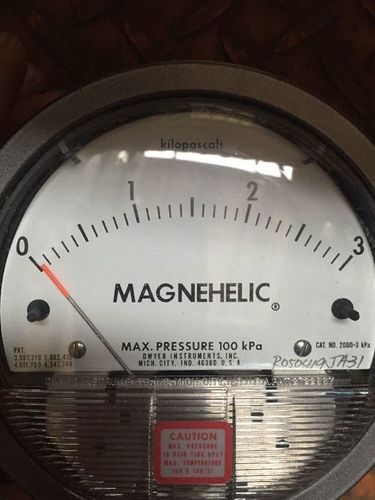
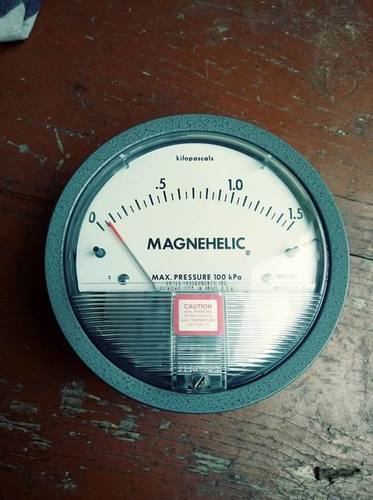
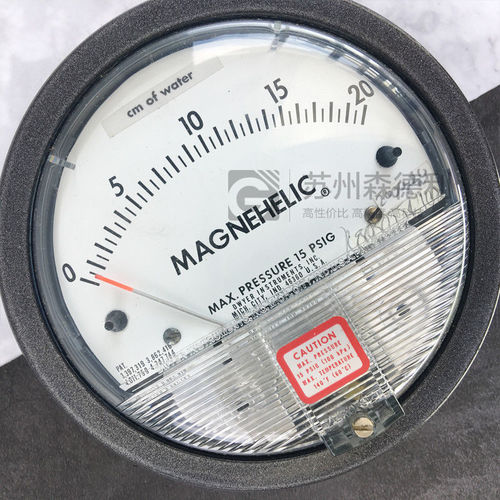
Dwyer Magnehelic Differential Pressure Gauge Model 2000-3KPA
Dwyer 2000-3KPA MAGNEHELIC, DIFFERENTIAL PRESSURE GAUGE, 0/3KPA
- Precision litho-printed scale is accurate and easy to read.
- Red tipped pointer of heat treated aluminum tubing is easy to see. It is rigidly mounted on the helix shaft.
- Pointer stops of molded rubber prevent pointer over-travel without damage.
- "Wishbone" assembly provides mounting for helix, helix bearings and pointer shaft.
- Jeweled bearings are shock-resistant mounted; provide virtually friction-free motion for helix. Motion damped with high viscosity silicone fluid.
- Zero adjustment screw is conveniently located in the plastic cover, and is accessible without removing the cover. O-ring seal provides pressure tightness.
- Helix is precision made from an alloy of high magnetic permeability. Mounted in jeweled bearings, it turns freely, following the magnetic field to move the pointer across the scale.
- Samarium Cobalt magnet mounted at one end of range spring rotates helix without mechanical linkages.
- Calibrated range spring is flat spring steel. Small amplitude of motion assures consistency and long life. It reacts to pressure on diaphragm. Live length adjustable for calibration.
- Silicone rubber diaphragm with integrally molded O-ring is supported by front and rear plates. It is locked and sealed in position with a sealing plate and retaining ring. Diaphragm motion is restricted to prevent damage due to overpressures.
- Die cast aluminum case is precision made and iridite-dipped to withstand 168 hour salt spray corrosion test. Exterior finished in baked dark gray hammerloid. One case size is used for all standard pressure options, and for both surface and flush mounting.
- Blowout plug of silicone rubber protects against overpressure on 15 psig rated models. Opens at approximately 25 psig.
- O-ring seal for cover assures pressure integrity of case.
Robust and Precise ConstructionCrafted from a die cast aluminum case and finished with powder coating, the Magnehelic 2000-3KPA boasts an injection-molded housing for enhanced durability. The clear acrylic cover protects the dial while allowing easy visibility and precise readings. This combination ensures reliable long-term use in demanding environments.
Simple Installation and Versatile MountingDesigned for effortless integration, this differential pressure gauge features two 1/8" NPT female pressure connections and supports both surface or panel mounting. Supplied with static pressure tips, mounting screws, and an instruction sheet, it provides all necessary components for streamlined installation in a variety of industrial settings.
Accurate Monitoring for Critical ApplicationsWith a scale range of 03 KPA and accuracy within 2% of full scale, the Magnehelic 2000-3KPA delivers dependable monitoring of differential pressure. Its diaphragm actuated sensor and external zero adjustment make it especially suitable for applications such as HVAC performance analysis, clean room environment control, and air filter monitoring.
FAQs of Dwyer Magnehelic Differential Pressure Gauge Model 2000-3KPA:
Q: How do I install the Dwyer Magnehelic Model 2000-3KPA differential pressure gauge?
A: Begin by securely mounting the gauge in a vertical orientation on a surface or panel using the included screws. Connect your high and low pressure lines to the two 1/8" NPT female ports, using the supplied plastic static pressure tips. Consult the instruction sheet for detailed wiring and mounting guidance.
Q: What types of media can be measured with this gauge?
A: The Magnehelic 2000-3KPA is engineered to monitor differential pressure of air and non-corrosive gases only. It is not recommended for use with liquids or corrosive gases, as this may damage the diaphragm or housing.
Q: When should I use the external zero adjustment feature?
A: External zero adjustment should be performed before each measurement session or after installation to ensure the pointer reads zero when no differential pressure is present. This adjustment compensates for minor installation or environmental changes, maintaining accuracy.
Q: Where is this pressure gauge typically used?
A: Ideal environments include HVAC ducts and systems, clean rooms, filtration monitoring setups, and other industrial air/gas applications requiring precise differential pressure measurement.
Q: What benefits does the analog dial provide compared to digital options?
A: The analog dial delivers rapid visual assessment and continuous, real-time pressure monitoring without battery reliance. Its high-contrast white polycarbonate dial and black aluminum pointer make readings both quick and clear.
Q: How does the overpressure limit contribute to gauge safety?
A: With an overpressure limit of 15 psi (1.0 bar), the gauge can safely withstand pressure spikes, reducing the risk of damage during operation or accidental surges in the system.






 Send Inquiry


 Send Inquiry


