About Dwyer DM-2004-LCD PRESSURE TRANSMITTER
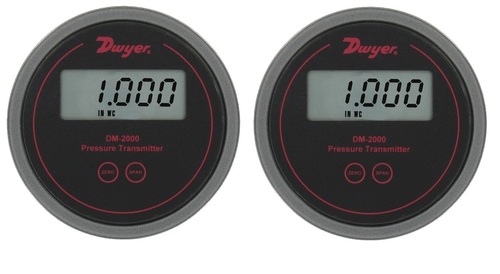
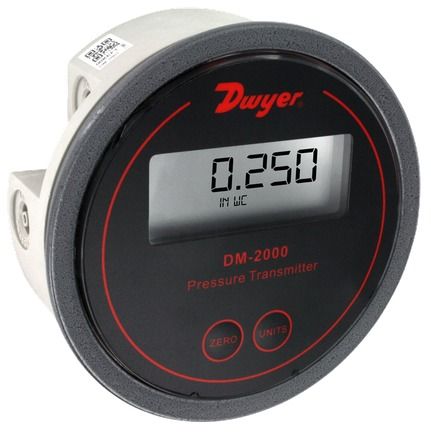
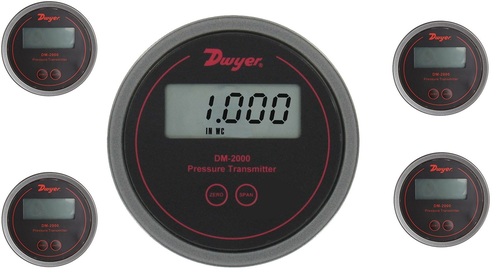
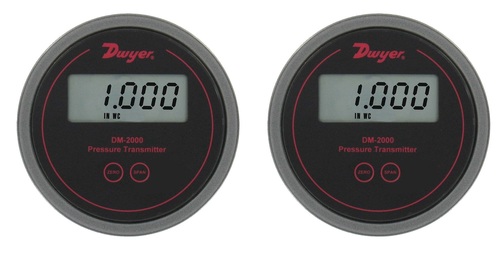
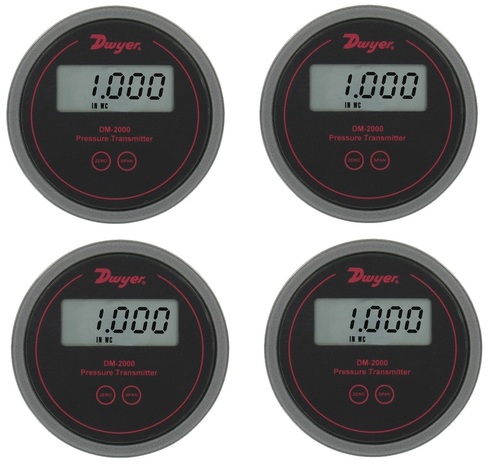
Dwyer DM-2004-LCD PRESSURE TRANSMITTER
- A wide range of models are available factory calibrated to specific ranges.
- Pressure connections are inherent to the glass filled plastic molded housing making installation quick and easy.
- Digital push-button zero and span simplify calibration over typical turn-potentiometers
- An optional 3.5 digit LCD shows process and engineering units.
- A single bush button allows field selection of 4 to 6 engineering units depending on range on LCD models.
Specifications
- Service: Air and non-combustible, compatible gases.
- Wetted Materials: Consult Factory.
- Accuracy: ±1% F.S. at 70°F.
- Stability: +1% F.S./yr.
- Temperature Limits: 20 to 120°F (-6.67 to 48.9°C).
- Pressure Limits: 10 psig (0.69 bar).
- Thermal Effect: ±0.055% F.S./°F (0.099% F.S./°C).
- Power Requirements: 10-35 VDC (2 wire).
- Output Signal: 4 to 20 mA.
- Zero and Span Adjustments: Digital push-button zero and span.
- Loop Resistance: DC: 0-1250 ohms maximum.
- Current Consumption: DC: 38 mA maximum.
- Electrical Connections: Screw-type terminal block.
- Display: 3.5 digit LCD, 0.7" height.
- Process Connections: 1/8" I.D. tubing.
- Mounting Orientation: Vertical.
- Weight: 4.8 oz (136 g).
Model
DM-2004-LCD
Description
Differential pressure transmitter, range 1.00" w.c., 249 Pa, 25.4 mm w.c., 2.49 mbar, .249 kPa.
Accurate Differential Pressure MeasurementThe DM-2004-LCD is engineered for precise monitoring of differential pressure in air handling units, cleanrooms, and ventilation systems. Its 1% of full scale accuracy ensures reliable data. The LCD digital display makes readings clear and accessible, even from a distance, supporting critical process control and ensuring environmental compliance.
Easy Installation and AdjustmentThe transmitter is designed for straightforward installation with wall or surface mounting options and 1/8 NPT female thread. External push-button zero and span adjustments make calibration and setup quick, reducing downtime and technical effort. The compact, durable ABS enclosure is finished with powder coating for added protection.
Durable Design for Industrial EnvironmentsWith IP54 enclosure protection, this transmitter withstands dust and moisture encountered in industrial settings. It operates efficiently across a temperature range of 0 to 50C and can be safely stored down to -10C. The units electronic processing and silicone sealing further extend its longevity and reliability.
FAQs of Dwyer DM-2004-LCD PRESSURE TRANSMITTER:
Q: How do I install the Dwyer DM-2004-LCD Pressure Transmitter?
A: The DM-2004-LCD can be installed using the supplied mounting hardware and user manual. It supports both wall and surface mounting, and the 1/8 NPT female connections simplify air or gas line fittings. Power the device with a 12-36 VDC supply.
Q: What pressure ranges are available for this transmitter?
A: The standard scale range is 0-250 Pa; however, the DM-2004-LCD also offers other range options to fit various applications. Please consult your supplier or user manual for custom range options.
Q: When should zero or span adjustments be performed?
A: Zero and span adjustments should be conducted during initial setup, after maintenance, or if readings appear inaccurate. The external push buttons on the device allow for easy recalibration as needed to ensure optimal performance.
Q: Where is this pressure transmitter typically used?
A: This transmitter is commonly used in HVAC systems, cleanrooms, laboratories, and other controlled environments where monitoring differential pressure of air or non-corrosive gases is essential.
Q: What are the benefits of the LCD digital display?
A: The integrated LCD display provides real-time, clear digital readouts, eliminating guesswork in pressure monitoring. It enhances readability for operators and simplifies troubleshooting and process adjustments.
Q: How does the DM-2004-LCD improve process efficiency?
A: With its fast response time (<100 ms), high accuracy (1% FS), and easy calibration, the DM-2004-LCD allows for prompt detection of pressure anomalies, reducing downtime and supporting consistent process control.






 Send Inquiry


 Send Inquiry


