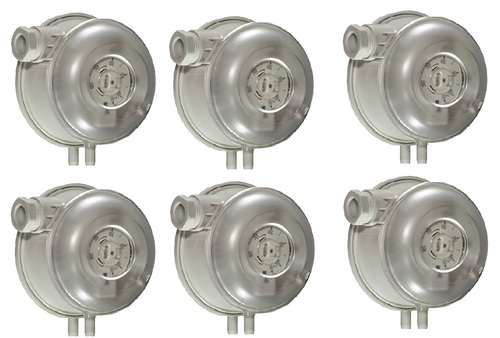
About Dwyer ADPS-08-2-N Adjustable Differential Pressure Switch
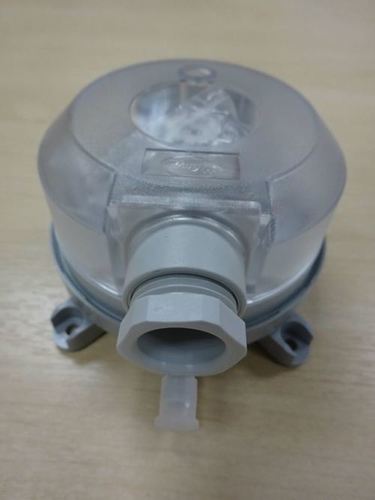
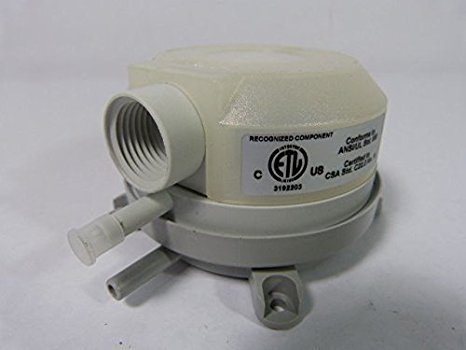
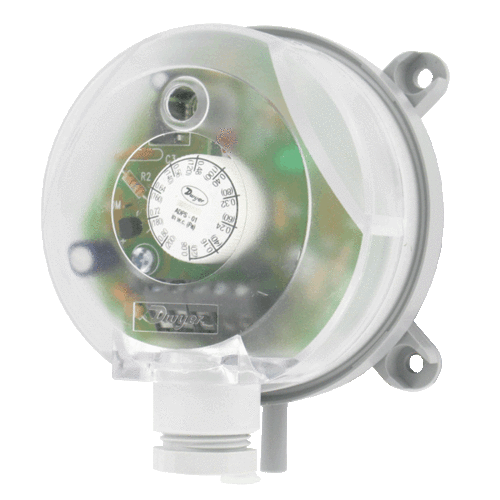
Dwyer ADPS-08-2-N Adjustable Differential Pressure Switch
Adjustable differential pressure switch, set point range 0.08 to 1.20" w.c., M20 connection.
Features
- Available with settings from 0.08" w.c. (20 Pa) up to 16" w.c. (4000 Pa)
- The silicone diaphragm and PA 6.6 body make the series ADPS ideal for use with air and other noncombustible gases
- The compact size, adjustment knob and low cost make the ADPS the perfect choice for HVAC applications
Specifications
- Service: Air and non-combustible, compatible gases
- Temperature Limits: Process and ambient temperature from -4 to 185°F (-20 to 85°C)
- Pressure Limits: Max. Operating Pressure: 40" w.c. (10 kPa) for all pressure ranges
- Switch Type: Single-pole double-throw (SPDT)
- Electrical Rating: Max., 1.5A/250 VAC, max. switching rate: 6 cycles/min.; Gold Contact Option: 0.4 A/ 250 VAC
- Electrical Connections: Push-on screw terminals. M20x1.5 with cable strain relief or optional 1/2" NPT connection
- Process Connections: 5/16" (7.94 mm) outside diameter tubing, 1/4" (6.0 mm) inside diameter tubing
- Enclosure Rating: NEMA 13, IP54
- Mounting Orientation: Vertically, with pressure connections pointing downwards
- Mechanical Working Life: Over 106 switching operations
- Weight: 5.6 oz (160 g)
Applications
- Monitoring air filters and ventilators
- Monitoring industrial cooling-air circuits
- Overheating protection for fan heaters
- Monitoring flows in ventilation ducts
- Controlling air and fire-protection dampers
- Frost protection for heat exchanges
Reliable Monitoring of Air and Gas PressureThe Dwyer ADPS-08-2-N delivers precise differential pressure switching for air and non-corrosive gases, helping ensure efficient operation of HVAC systems and process controls. Its IP54/NEMA 13 grade enclosure and ABS construction make it suitable for installation in demanding industrial environments where safety and performance are crucial.
Flexible Installation with User-Friendly DesignThanks to its compact, lightweight form (approximately 150g) and knob-adjustable set point, the ADPS-08-2-N is easy to mount and configure on panels or ducts. Included accessories, such as mounting screws and pressure connectors, simplify setup and promote secure, long-lasting installation in varied applications.
FAQ's of Dwyer ADPS-08-2-N Adjustable Differential Pressure Switch:
Q: How do I install the Dwyer ADPS-08-2-N differential pressure switch?
A: You can install the ADPS-08-2-N directly onto a panel or duct using the provided mounting screws. Connect the pressure ports to 1/8" OD tubing for your air or non-corrosive gas lines, and wire the SPDT electrical terminals as shown in the included installation manual.
Q: What are the main applications for this pressure switch?
A: This switch is designed primarily for monitoring differential pressure of air and non-corrosive gases in HVAC systems, air handling units, filter monitoring, and various industrial process control scenarios.
Q: When should I adjust the pressure set point, and how is it done?
A: Adjust the set point using the knob whenever you need to alter the differential pressure threshold for triggering the switch. Setting should be done according to the requirements of your system, within the 20 to 200 Pa scale range indicated on the device.
Q: Where can the ADPS-08-2-N be installed safely?
A: With its IP54/NEMA 13 rated enclosure and durable ABS construction, the switch can be mounted indoors in industrial environments where it may encounter dust or splashed water, but should be protected from outdoor weather exposure.
Q: What is the advantage of SPDT (Single-Pole Double-Throw) switching for this device?
A: SPDT switching enables the ADPS-08-2-N to control two different circuits simultaneously, providing increased flexibility for automation and control systems requiring a changeover function based on differential pressure.
Q: How precise is the ADPS-08-2-N differential pressure switch?
A: It offers an accuracy of 15% of the set point, making it suitable for a broad range of monitoring tasks where moderate precision is acceptable for protecting equipment or signalling filter maintenance.
Q: What benefits do distributors and industrial end-users in India gain from this model?
A: Distributors and industrial users benefit from the reliable performance, straightforward installation, robust build, and flexible mounting options. The inclusion of installation accessories and a comprehensive manual further supports quick deployment and dependable service in Indian industrial settings.