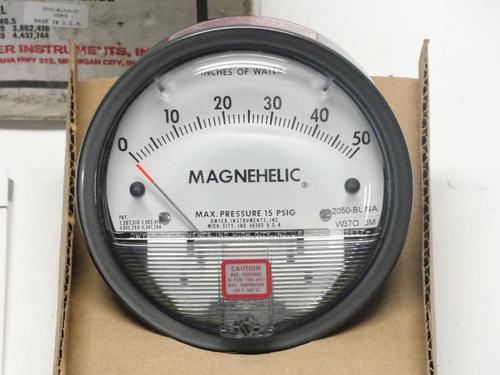
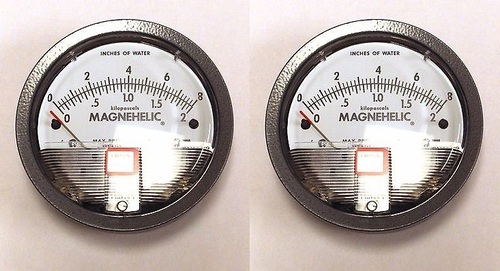
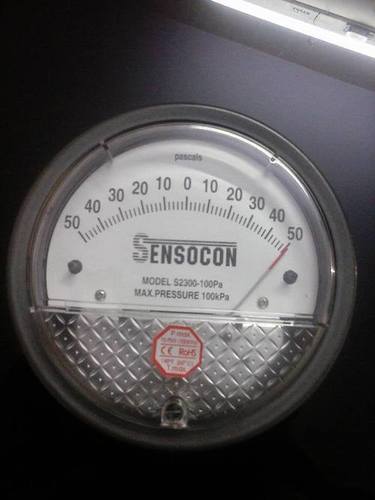
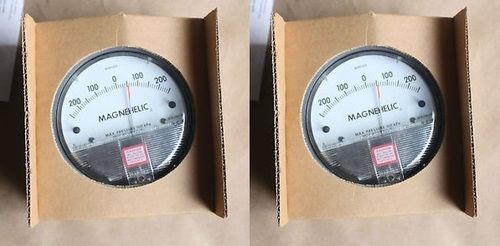
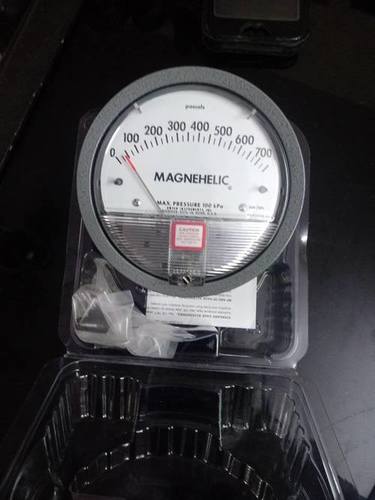
About DWYER USA Magnehelic Gauges 0 To 50 MM WC
DWYER USA Magnehelic Gauges 0 To 50 MM WC
Service: | Air and non-combustible, compatible gases (natural gas option available). Note: May be used with hydrogen. Order a Buna-N diaphragm. Pressures must be less than 35 psi |
Wetted Materials: | Consult factor |
Housing: | Die cast aluminum case and bezel, with acrylic cover. Exterior finish is coated gray to withstand 168 hour salt spray corrosion test |
Accuracy: | ±2% of FS (±3% on - 0, -100 Pa, -125 Pa, 10MM and ±4% on - 00, -60 Pa, -6MM ranges), throughout range at 70°F (21.1°C |
Pressure Limits: | -20 in Hg to 15 psig (-0.677 to 1.034 bar); MP option: 35 psig (2.41 bar); HP option: 80 psig (5.52 bar). |
Overpressure: | Relief plug opens at approximately 25 psig (1.72 bar), standard gages only. See Overpressure Protection Note on next page |
Temperature Limits: | 20 to 140°F* (-6.67 to 60°C). -20°F (-28°C) with low temperature option |
Size: | 4 (101.6 mm) diameter dial face |
Mounting Orientation: | Diaphragm in vertical position. Consult factory for other position orientations |
Standard Accessories: | Two 1/8 NPT plugs for duplicate pressure taps, two 1/8 pipe thread to rubber tubing adapter, and three flush mounting adapters with screws. (Mounting and snap ring retainer substituted for three adapters in MP & HP gage accessories.) |
Rugged Design & Reliable PerformanceBuilt with a die-cast aluminum case and powder-coated housing, the Magnehelic Gauge stands up to harsh industrial conditions. Its IP67 rating ensures resistance to both dust and water, making it suitable for a wide range of demanding environments.
Accurate Differential Pressure MeasurementDesigned for a measurement range of 0 to 50 mm WC, this gauge delivers reliable results with 2% full-scale accuracy. The clear analog dial and precision balanced pointer make readings straightforward and dependable during filter, room, or air velocity monitoring.
Easy Installation & MaintenanceWith side and back connection options, external zero adjustment, and included mounting brackets, setting up the Magnehelic Gauge is hassle-free. Maintenance is simplified thanks to a clear acrylic glass face, and panel or surface mounting flexibility.
FAQs of DWYER USA Magnehelic Gauges 0 To 50 MM WC:
Q: How do I install the DWYER Magnehelic Gauge for pressure monitoring?
A: To install the Magnehelic Gauge, use the provided mounting brackets and hardware to secure it to a surface or panel. Choose either the side or back 1/8 NPT female connection, ensuring airtight fittings, and connect to air or non-corrosive gas lines. Follow all safety protocols relevant to your working environment.
Q: What applications are suitable for the Magnehelic Gauge 0-50 mm WC?
A: This model is ideal for filter monitoring, measuring room differential pressure, checking blower vacuum levels, and monitoring air velocity in HVAC and cleanroom settings. Its accuracy and reliability make it a preferred choice for industrial and commercial air handling systems.
Q: When should I perform zero adjustment on this gauge?
A: Zero adjustment should be performed whenever the gauge is installed for the first time, after relocation, or if you notice baseline drift during operation. Use the external adjustment screw on the front of the gauge to calibrate the needle to zero before each new usage or after maintenance.
Q: Where can I mount the Magnehelic Gauge in my setup?
A: The gauge is designed for versatility and can be installed on a flat surface or panel using the included brackets. Thanks to its compact size and dual connection ports (side and back), it can be integrated into existing panels, control systems, or directly onto equipment.
Q: What benefits does the diaphragm sensing mechanism provide?
A: The diaphragm sensing mechanism ensures stable, repeatable readings and is less susceptible to mechanical stress compared to Bourdon tube designs. This method delivers reliable performance across a wide temperature range and simplifies maintenance.
Q: How do I maintain the Magnehelic Gauge for optimal accuracy?
A: Routine cleaning of the clear acrylic dial cover and periodic zero calibration help maintain accuracy. Ensure all connections remain airtight, and inspect the neoprene gasket for wear. Avoid using with corrosive gases or exposing the gauge to conditions outside the rated temperature and pressure.
Q: What is the maximum overpressure the Magnehelic Gauge can tolerate?
A: This model is engineered to withstand overpressures up to 172 kPa (2.5 psi), which protects the internal components in the event of temporary system surges and enhances product longevity.