About Dwyer 2010D Magnehelic Differential Pressure Gauge
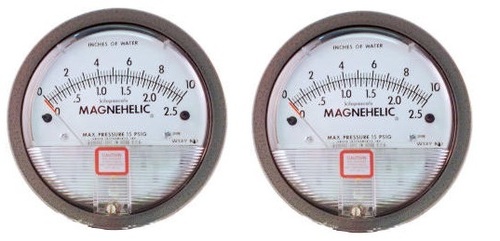
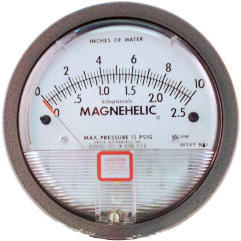
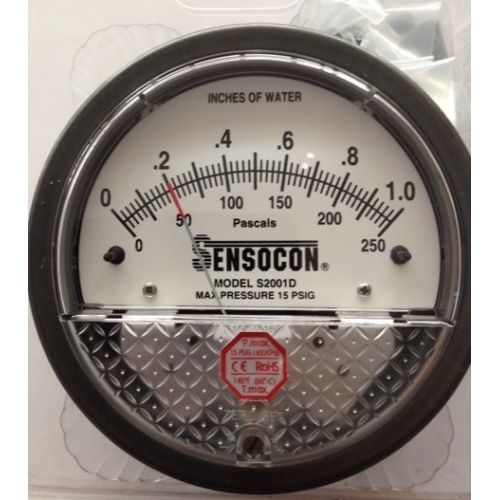
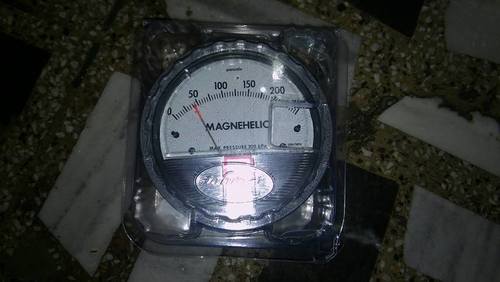
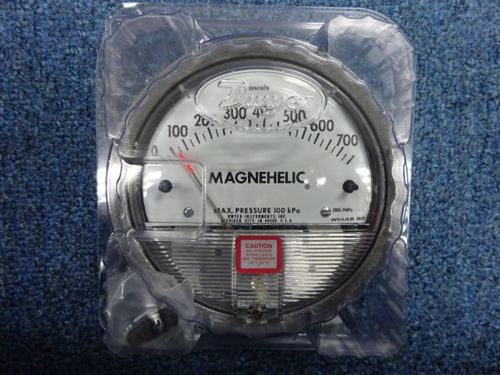
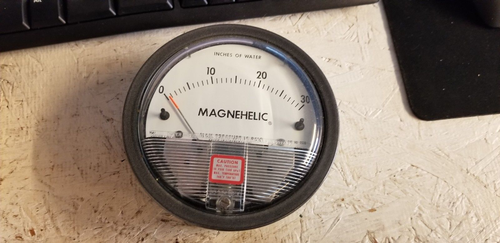
Dwyer 2010D Magnehelic Differential Pressure Gauge
Dwyer Instruments 2010D
Differential Pressure Gage 0-10"WC
Select the Magnehelic gage for high accuracy--guaranteed within 2% of full scale--and for the wide choice of 81 models available to suit your needs precisely. Using Dwyer's simple, frictionless Magnehelic gage movement, it quickly indicates low air or non-corrosive gas pressures--either positive, negative (vacuum) or differential. The design resists shock, vibration and over-pressures. No manometer fluid to evaporate, freeze or cause toxic or leveling problems. It's inexpensive, too. The Magnehelic gage is the industry standard to measure fan and blower pressures, filter resistance, air velocity, furnace draft, pressure drop across orifice plates, liquid levels with bubbler systems and pressures in fluid amplifier or fluidic systems. It also checks gas-air ratio controls and automatic valves, and monitors blood and respiratory pressures in medical care equipment.
Product Highlights
- Bezel provides flange for flush mounting in panel.
- Clear plastic face is highly resistant to breakage. Provides undistorted viewing of pointer and scale.
- Precision litho-printed scale is accurate and easy to read.
- Red tipped pointer of heat treated aluminum tubing is easy to see. It is rigidly mounted on the helix shaft.
- Pointer stops of molded rubber prevent pointer over-travel without damage.
- "Wishbone" assembly provides mounting for helix, helix bearings and pointer shaft.
- Jeweled bearings are shock-resistant mounted; provide virtually friction-free motion for helix. Motion damped with high viscosity silicone fluid.
- Zero adjustment screw is conveniently located in the plastic cover, and is accessible without removing the cover. O-ring seal provides pressure tightness.
- Helix is precision made from an alloy of high magnetic permeability. Mounted in jeweled bearings, it turns freely, following the magnetic field to move the pointer across the scale.
- Calibrated range spring is flat spring steel. Small amplitude of motion assures consistency and long life. It reacts to pressure on diaphragm. Live length adjustable for calibration.
- Silicone rubber diaphragm with integrally molded O-ring is supported by front and rear plates. It is locked and sealed in position with a sealing plate and retaining ring. Diaphragm motion is restricted to prevent damage due to overpressures.
- Die cast aluminum case is precision made and iridite-dipped to withstand 168 hour salt spray corrosion test.
- Exterior finished in baked dark gray hammerloid. One case size is used for all standard pressure options, and for both surface and flush mounting.
Overpressure Protection
Blowout plug is comprised of a rubber plug on the rear which functions as a relief valve by unseating and venting the gage interior when over pressure reaches approximately 25 PSIg (1.7 bar). To provide a free path for pressure relief, there are four spacer pads which maintain 0.023" clearance when gage is surface mounted. Do not obstruct the gap created by these pads. The blowout plug is not used on models above 180" of water pressure, medium or high pressure models, or on gages which require an elastomer other than silicone for the diaphragm. The blowout plug should not be used as a system overpressure control. High supply pressures may still cause the gage to fail due to over pressurization, resulting in property damage or serious injury. Good engineering practices should be utilized to prevent your system from exceeding the ratings or any component.
O-ring seal for cover assures pressure integrity of case. Samarium Cobalt magnet mounted at one end of range spring rotates helix without mechanical linkages.
Range 0-10 in H2O
0-2.5 kPa
Precision Measurement for Air and Gas SystemsThe Dwyer 2010D is widely used in monitoring pressure across filters, fans, blowers, or for cleanrooms, ensuring optimal system operation and safety. Thanks to its mechanical diaphragm sensor, it is specifically calibrated for accuracy, providing reliable readings for industrial applications.
Durable Construction and Flexible MountingConstructed with a die-cast aluminum case and protected by an IP54-rated enclosure, the 2010D gauge stands up to tough industrial conditions. Its mountings support both surface and flush installation, offering versatility for various configurations.
User-Friendly Adjustments and Clear DisplayThis model is equipped with an external screw for easy zero adjustment and a polycarbonate dial for clear, at-a-glance readings. Accessories like mounting screws and tubing simplify installation, while the anodized aluminum pointer ensures durability and precision.
FAQs of Dwyer 2010D Magnehelic Differential Pressure Gauge:
Q: How do I install the Dwyer 2010D Magnehelic Differential Pressure Gauge?
A: You can install the 2010D gauge using either surface or flush mounting, according to your application needs. It is supplied with mounting screws, tubing, and static pressure tips, and requires a vertical mounting orientation for accurate readings.
Q: What pressure media can I measure with this gauge?
A: This gauge is designed for monitoring the differential pressure of air and non-corrosive gases, making it ideal for ventilation systems, air handlers, and similar environments.
Q: When should I use the zero adjustment screw?
A: Use the external zero adjustment screw to calibrate the gauge before initial operation or if you notice any deviation from zero under no pressure. Ensuring accurate zeroing maintains measurement reliability.
Q: Where can I install the Dwyer 2010D Magnehelic gauge?
A: This gauge is suited for industrial installations where protection against dust and limited moisture (IP54 rating) is adequate. It can be mounted in control panels or directly onto equipment that requires pressure monitoring.
Q: What benefits does the analog dial and mechanical design offer?
A: The analog dial provides immediate, easy-to-read visual feedback, while the robust mechanical diaphragm sensor ensures reliable measurements without the need for external power.
Q: How do I ensure optimal performance and accuracy of the gauge?
A: Install the gauge vertically according to the manufacturers instructions, avoid exceeding the 15 psi overpressure limit, and regularly perform zero adjustment checks to maintain 2% accuracy.






 Send Inquiry


 Send Inquiry


